
 Available in US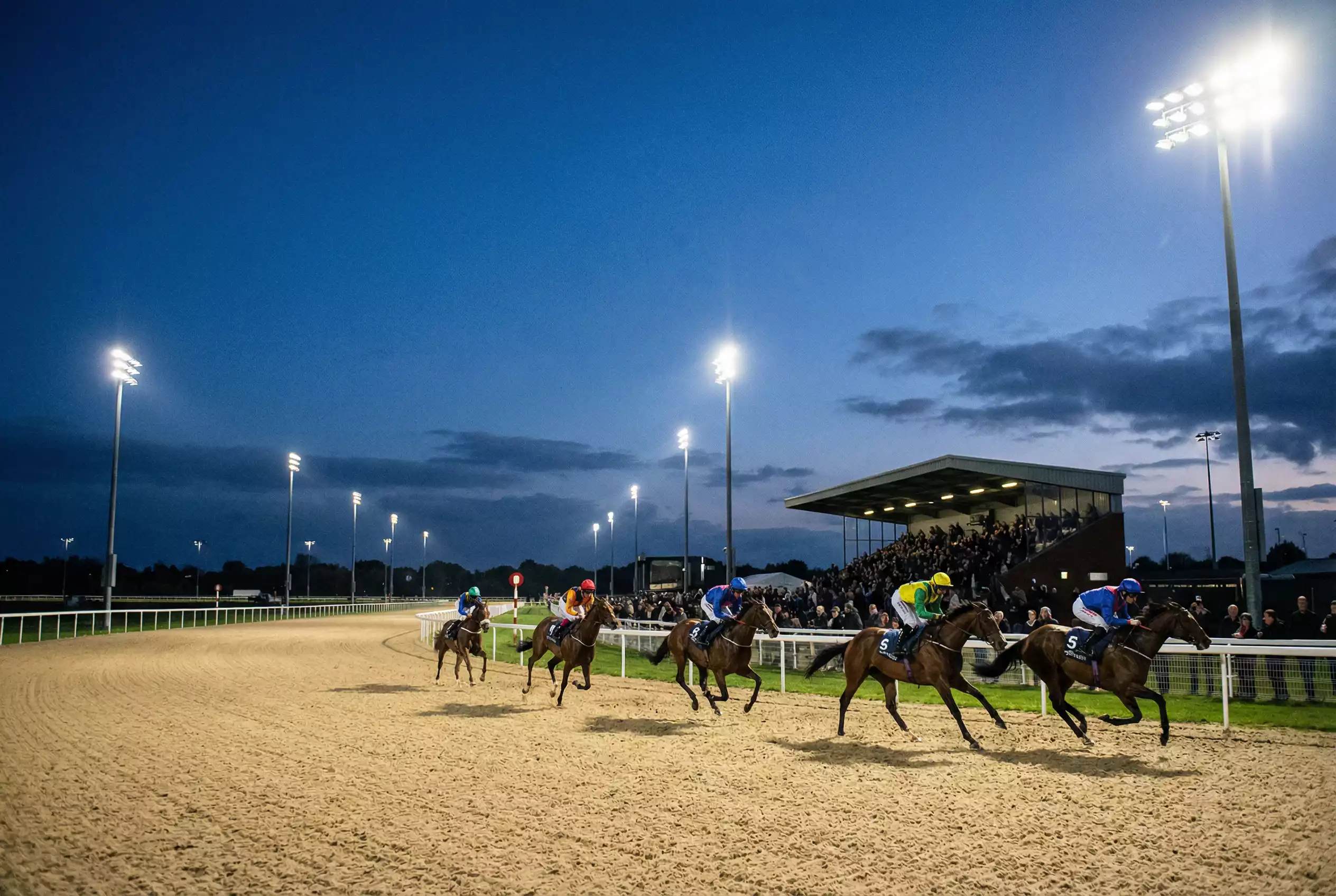
Southwell evening racing has become a fixture of the weekly schedule for British racing followers. Since the installation of LED floodlights in 2019 — the first of their kind at any racecourse in Europe — evening cards have grown from a novelty into a commercial staple, filling the gap between afternoon turf action and the end of the betting day. The track now hosts regular floodlit meetings throughout the autumn, winter and early spring, offering a steady flow of all-weather Flat racing after dark. Southwell Evening Racing — More on this topic at southwell race results.
For punters, Southwell’s evening programme presents a specific set of conditions: lower-class fields, a unique atmosphere under artificial light, and betting markets that behave differently from afternoon cards. Understanding those conditions is the difference between approaching an evening meeting informed and approaching it blind.
The LED Lighting System: A European First
The floodlights at Southwell were installed in 2019 using state-of-the-art LED technology supplied as part of Arena Racing Company’s ongoing investment in the venue. At the time, no other racecourse in Europe had been fully lit by LEDs. Other all-weather venues — Wolverhampton and Kempton, for example — had been running evening meetings for years under conventional floodlighting, but Southwell leapfrogged them technically with a system that offers better colour rendering, lower energy consumption and more precise control over light distribution across the track.
The practical benefit for horses and jockeys is a more uniform light spread. Conventional floodlights can create pockets of shadow on bends and in the home straight, which unsettle some horses and make it harder for jockeys to judge distances. The LED array at Southwell reduces those inconsistencies, providing illumination that approximates overcast daylight conditions more closely than older systems manage. This matters for the integrity of results, too: fewer lighting-related incidents means fewer stewards’ enquiries triggered by interference that might have been avoidable under better visibility.
The system covers the entire oval, including the five-furlong straight course, and can illuminate the parade ring and winner’s enclosure to broadcast-quality levels. Sky Sports Racing, which televises all Southwell meetings, worked with the racecourse to ensure that the lighting meets the technical specifications for high-definition broadcast without introducing glare or colour distortion on screen. The investment was not cheap, but it unlocked a significant increase in the number of fixtures Southwell could stage each year — and with it, a corresponding increase in media-rights revenue and racecourse income.
Since the installation, the LED system has required relatively modest maintenance compared with conventional alternatives. There have been no reported fixture cancellations due to lighting failure — an operational reliability record that reinforces the decision to invest in the technology. The floodlights are also fully controllable from a central console, allowing the operations team to adjust brightness levels and coverage zones for different meetings and weather conditions. Other ARC-owned venues have since examined similar upgrades, using Southwell as the proof of concept for a technology that may eventually become standard across the all-weather circuit.
Typical Evening Card: Class, Distance and Field Sizes
A standard Southwell evening card consists of six or seven races, almost exclusively on the Tapeta all-weather surface. First race times vary but typically fall between 4:30pm and 5:30pm, with the final race finishing around 8:00 to 8:30pm. The turf jumps course does not operate under floodlights, so evening meetings are always AW Flat affairs — no hurdles, no chases, no bumpers.
The class profile skews towards the lower tiers. Class 6 handicaps are the single most common race type on an evening card, followed by Class 5 handicaps and classified stakes. Occasional restricted novice stakes or fillies’ events appear, but the bulk of the programme is aimed at the working-class horse: the well-handicapped veteran, the unexposed four-year-old and the reliable sort that turns up every few weeks. This is grassroots Flat racing, and it has its own rhythm — unpretentious, competitive and occasionally unpredictable.
Distances on evening cards cover most of the range available at Southwell: five furlongs on the straight course, six and seven furlongs on the round, a mile, and middle distances up to a mile and six furlongs. Staying trips beyond that are rare on evening cards, as the programme tends to favour the shorter and middle-distance events that attract the largest fields. Sprint races over five furlongs, in particular, are popular evening fixtures because they produce quick, decisive results that keep the card moving.
Field sizes on evening cards are generally comparable to afternoon meetings — frequently reaching eight or more runners per race. The all-weather programme has consistently delivered healthier field sizes than equivalent turf fixtures during the same period, and evening meetings are no exception. Trainers with horses suited to Southwell’s Tapeta view the evening slots as low-friction opportunities: the travel distances are short for Midlands-based yards, the class levels are familiar, and the prize money, while modest, covers expenses for a well-placed runner.
Betting on Evening Meetings: Liquidity and Value
Evening racing at Southwell occupies an unusual position in the betting landscape. The audience is smaller than for a Saturday afternoon at a major turf venue, but it is also more focused: the people betting on a Tuesday evening all-weather card at Southwell are, by and large, people who do this regularly. The casual once-a-year punter is not typically watching a Class 6 handicap over six furlongs at 7pm on a Wednesday in November.
That audience composition affects market behaviour. Betting turnover per race across British racing has been declining — the average fell by approximately eight per cent in 2024/25 compared with the previous year, according to data from the Horserace Betting Levy Board’s annual report. Evening meetings are not immune to this trend, and lower overall turnover means less liquidity in the betting exchanges. Odds can be thinner, and it can be harder to place larger bets at exchange prices without moving the market.
On the flipside, thinner markets can create value for those who do their homework. When fewer eyes are on a race, prices more accurately reflect the opinions of a smaller number of bettors — and if that smaller group has overlooked a relevant angle, the inefficiency can persist until close to post time. Course-and-distance form, trainer patterns and jockey bookings that would be instantly priced into a competitive Saturday afternoon market can slip through the cracks on an evening card.
One practical consideration for evening betting: bookmaker streaming services often show Southwell evening meetings as part of their live coverage, making it possible to watch and assess the horses in the parade ring before the off. This is a genuine informational advantage at the lower class levels, where visual indicators — how a horse is moving, whether it looks well, how it behaves going to post — can tell you things that the form book cannot. See also Southwell Track Bias.
The evening programme at Southwell is unlikely to produce the next Derby winner. But for informed punters who treat it seriously, it provides a regular stream of opportunities at a track whose patterns and tendencies reward attention. The floodlights may be new, but the data has been accumulating since December 2021, and four years of Tapeta-era form is enough to build a working model of what wins here after dark.
