
 Available in US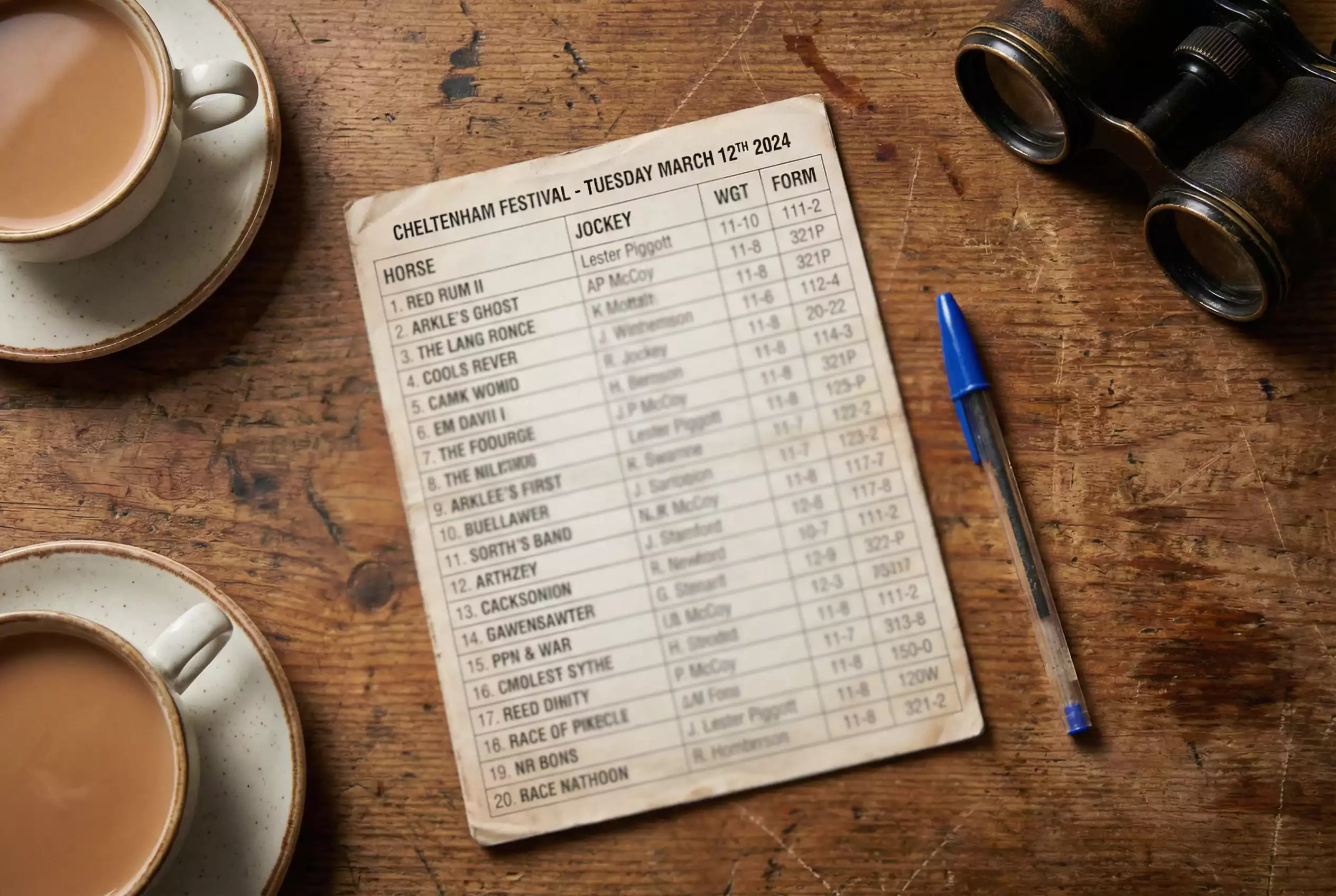
A Southwell racecard is the pre-race document that tells you everything the organisers consider relevant about the runners and riders before the off. It lists the horses, their jockeys, trainers, weights, draw positions, form figures and assorted codes that — if you know how to read them — contain more predictive information than most punters ever extract. The racecard is not a result; it is the blueprint from which a result will be built. Southwell Racecards Explained — More on this topic at southwell race results.
Southwell racecards follow the same format used at every racecourse in Britain, but the specific context of this track — its Tapeta surface, its tight left-handed layout, its concentration of lower-class handicaps — means that certain columns carry more weight here than they might elsewhere. What follows is a column-by-column guide to reading Southwell’s runners and riders with the analytical eye they deserve.
Racecard Columns: What Each One Tells You
Every racecard begins with the basics: the race number, time, title, class, distance and prize money. These tell you what kind of race you are looking at before you consider a single runner. At Southwell, most races are Class 5 or Class 6 handicaps on the all-weather, so the class and surface columns are worth checking — particularly when an occasional Class 4 or a National Hunt fixture appears on the card and shifts the quality threshold.
The draw column shows the stall number allocated to each horse. At Southwell, draw matters most in five-furlong sprints and six-furlong races that include the left-handed bend. In sprints with large fields, higher draws have shown a marginal edge on the straight course. Over six furlongs, lower draws save ground through the turn. Beyond seven furlongs, the draw is largely irrelevant because the field has time to settle into position before the stall number matters.
The weight column indicates how much each horse carries, expressed in stones and pounds. In handicaps — the most common race type at Southwell — the weight is determined by the horse’s Official Rating, with higher-rated horses carrying more. The weight range in a typical Southwell handicap might run from 9st 7lb at the top to 8st 2lb at the bottom, a spread of nineteen pounds that represents a significant difference in the handicapper’s assessment of each runner’s ability. Horses at the foot of the weights are receiving a considerable allowance from those at the top, and if a low-weighted runner is drawn well and ridden by a jockey who claims a further allowance, the combined advantage can be decisive.
The jockey column is self-explanatory but never trivial. At Southwell, certain riders have demonstrably better records than others, and a jockey booking can shift the probability of a result by a measurable margin. The trainer column matters equally. When a trainer with a strong Southwell record sends a runner to the track, it signals intent: this is a horse the yard expects to run well in these specific conditions.
Form figures appear as a string of numbers and letters next to each horse’s name. The most recent run is on the right. A “1” means a win; “2” means second; “0” means finished outside the first nine; “F” means fell; “U” means unseated; a dash separates seasons. Reading form figures is a skill in itself, but at the racecard stage, the immediate question is simple: has this horse shown it can compete at this level, at this distance, on this surface? A string of mid-division finishes at other venues tells you less than a single placed effort at Southwell on Tapeta.
The days-since-last-run figure, often shown alongside the form, indicates how long a horse has been absent from the track. At Southwell’s class level, horses that have been off for more than sixty days are often less reliable than those that have raced within the past three to four weeks. A quick turnover is common among all-weather regulars, and freshness matters less than routine at this end of the market.
Headgear Codes and Equipment Changes
Racecards include codes indicating whether a horse is wearing headgear — equipment fitted to the horse’s head that is designed to improve focus, control or vision during a race. At Southwell, where fields are often filled with horses that have run many times and developed habits, headgear changes are worth monitoring closely.
The most common codes are: “b” for blinkers — cups fitted to a hood that restrict the horse’s rear and lateral vision, forcing it to focus forward; “v” for a visor, which is similar to blinkers but with a slit that allows partial peripheral vision; “t” for a tongue tie, a strap that prevents the horse from getting its tongue over the bit, which can improve breathing; “h” for a hood, a full head covering often used in the paddock and removed before the race starts; “e/s” for eye shields, which are like blinkers but typically used only in the parade ring and removed at the start; and “p” for cheekpieces, strips of sheepskin attached to the cheek straps of the bridle that narrow the horse’s field of vision without being as restrictive as blinkers.
The critical detail is whether the headgear is being applied for the first time. A “1” superscript next to the headgear code — for example, “b1” — means first-time blinkers. This is a significant signal. Trainers apply first-time headgear when they believe a horse needs a tactical change: it may have been running lazily, hanging to one side, or losing focus in the closing stages. The first-time application is the point of maximum impact. Statistically, horses wearing blinkers or a visor for the first time produce a noticeable uptick in performance across British racing, and Southwell is no exception.
Conversely, headgear that has been on for many runs without improvement suggests the equipment change has not worked. A horse wearing blinkers for the fifteenth time and still finishing mid-division has probably told you all it is going to tell you. The racecard makes this visible: the headgear code appears alongside the form, and cross-referencing the two reveals whether the equipment has correlated with better — or worse — results.
Using Racecards to Anticipate Southwell Results
The racecard is a snapshot taken before the race happens. Its value lies in helping you build an expectation of how the race will unfold — who will lead, who will be held up, where the pace will come from and which horses are best positioned to exploit the conditions.
At Southwell, three racecard elements carry disproportionate predictive power. The first is the trainer-jockey combination. According to OLBG’s five-year data, certain pairings produce strike rates far above the venue average — James Doyle in novice races, for instance, has won seven of fourteen rides at a fifty per cent clip, generating a level-stake profit of +29.60. When a high-performing combination appears on the racecard, it deserves more attention than the horse’s bare form figures might suggest.
The second is the draw-distance interaction. A glance at the draw column relative to the race distance tells you immediately whether a horse has a positional advantage or a potential problem. In a twelve-runner six-furlong handicap, a horse drawn in stall two has a measurably better chance of saving ground through the bend than one drawn in stall eleven. The racecard makes this comparison trivial — it is there in black and white, waiting to be used. See also Southwell Going Report.
The third is headgear changes, as discussed above. A first-time application of blinkers or a visor on a horse that has been underperforming is the kind of signal that casual racecard readers miss and serious analysts build into their assessments. The racecard does not hide this information. It prints it in plain sight. The edge comes from knowing what to do with it.
