
 Available in US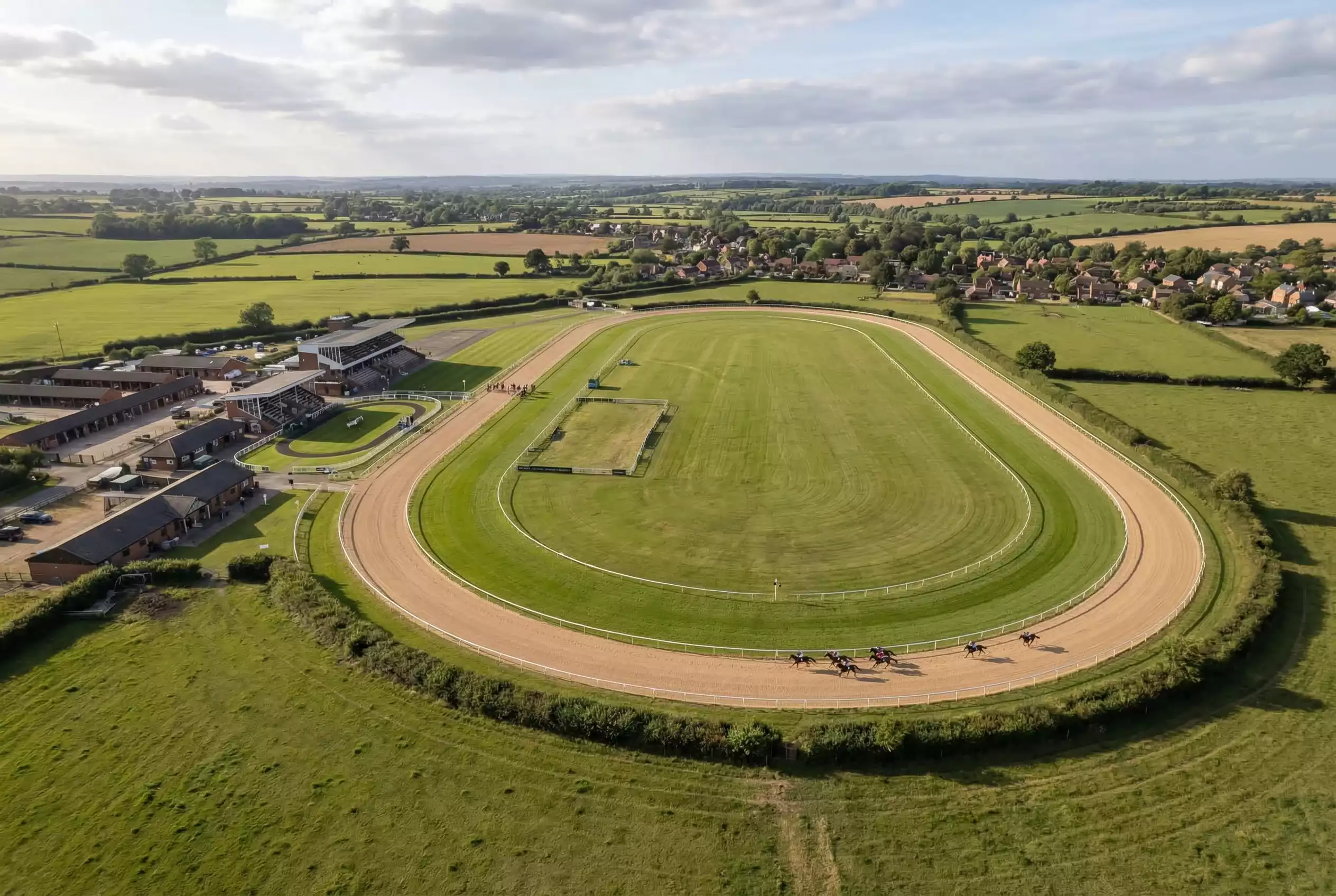
Southwell racecourse history stretches back well over a century, though the track that exists today bears almost no resemblance to the one that staged its first meeting in 1898. The venue has survived two world wars, a fatal accident that revoked its licence, catastrophic flooding, a controversy involving illegal drones, and a complete change of racing surface. Through all of it, the course at Rolleston has kept going — adapting, rebuilding and reinventing itself in ways that most of its contemporaries never needed to. Southwell Racecourse History — More on this topic at southwell race results.
The timeline that follows is not a dry archive. It is the story of how a modest Nottinghamshire track became one of the busiest racecourses in Britain — the only venue in the country to race on Fibresand for thirty-two consecutive years, from 1989 to 2021, before joining the Tapeta era that now defines all-weather racing in the UK.
The Early Years: 1898 and the Kirklington Road Track
Informal horse racing in the Southwell area can be traced to the mid-nineteenth century, when local landowners would organise match races on open ground near the town. As the gatherings attracted larger crowds, a temporary track was laid on Kirklington Road — close to where the current racecourse stands but not on the same site. The arrangement was rudimentary: the course reportedly crossed a public road in two places, with temporary turf laid over the top to create an uninterrupted racing line.
The Kirklington Road layout was never going to last. The public road crossing was dangerous for horses, jockeys and spectators alike, and in 1897 a jockey was killed and several horses died during racing. The incident led to the immediate revocation of Southwell’s racing licence. It was a brutal end to the town’s first experiment with organised racing, but the appetite for the sport was not extinguished.
The current racecourse was built the following year, in 1898, on a new site near the village of Rolleston. A grandstand with a capacity of around 1,200 spectators was constructed, and the track was laid out as a conventional turf circuit. Racing resumed, and Southwell settled into a pattern of modest flat and jumps meetings that would continue, with interruptions for the two world wars, for the best part of a century. During the First World War, racing was suspended and the site was repurposed. The same happened in the Second World War, when the Royal Air Force used the racecourse grounds as a storage depot.
Between the wars and in the decades that followed, Southwell operated as a small, unpretentious turf track. It was not one of the sport’s glamour venues — it had no classics, no Group races, no headline meetings. What it had was a loyal local following and a management that understood the value of keeping the gates open and the programme running. That pragmatic streak would prove decisive when the opportunity to do something genuinely pioneering arrived in the late 1980s.
All-Weather Pioneers: When Fibresand Arrived in 1989
In November 1989, Southwell became one of the first racecourses in Britain to host all-weather racing, and the only one to do so on a Fibresand surface. The decision to install an artificial track was driven by a straightforward commercial logic: turf racing is hostage to the weather, and a track that could race year-round, regardless of rain, frost or drought, would generate far more revenue than one limited to the traditional seasons.
Fibresand — a mixture of silica sand and elastic synthetic fibres — was chosen as the surface. It was deep, demanding and produced significant kickback, which gave Southwell an identity unlike any other track in the country. Horses either handled it or they did not, and the ones that thrived on it built up remarkable course records. The surface was also markedly slower than the Polytrack used at Lingfield and Kempton, which meant that speed figures from Southwell could not be directly compared with other all-weather venues.
The first all-weather National Hunt meeting in Britain was staged at Southwell in November 1989, though the surface was subsequently reserved exclusively for Flat racing. The all-weather track ran around the outside of the existing turf course, creating a dual-purpose venue that could host both codes. It was a layout that worked well enough to sustain over fifty fixtures a year, making Southwell one of the most active racecourses in the country by volume.
Over the next three decades, the Fibresand surface was refurbished and maintained at considerable expense. A £120,000 renovation of the back straight in 2016 addressed drainage issues that had plagued that section of the track. But the surface was ageing, and by the late 2010s it was clear that Fibresand had reached the end of its operational life. The industry was moving towards Tapeta, which had been successfully installed at Wolverhampton in 2014 and Newcastle in 2016, and Southwell was the last holdout.
Flooding, Drones and the Switch to Tapeta
The final decade of the Fibresand era was not a quiet one. In December 2012, severe flooding caused major damage to both the track and the buildings on site. Meetings were transferred to Wolverhampton and Lingfield while repairs were carried out, and the course did not reopen until February 2013, initially with limited capacity. The episode was a reminder of how vulnerable the low-lying site near the River Trent is to extreme weather — a vulnerability that would resurface with even greater force a decade later.
In January 2019, Southwell made national headlines for an entirely different reason: drones. Unmanned aircraft were spotted flying over the racecourse during live racing, broadcasting footage over the internet. The significance was not just a matter of trespass. Drone footage was estimated to be up to two seconds ahead of the official broadcast feed, giving anyone watching the drone stream a financial edge over punters betting in-play through licensed channels. The BHA and local authorities investigated, but the drones were not technically illegal under existing legislation, and the controversy highlighted a gap in the sport’s regulatory framework that took years to address.
That same year — 2019 — brought a more positive milestone: the installation of LED floodlights, making Southwell the first racecourse in Europe to be lit entirely by LED technology. The lights enabled evening fixtures on the all-weather, expanding the track’s programme and its commercial value.
The decisive change came in 2021, when Arena Racing Company confirmed the replacement of Fibresand with Tapeta. Work was completed by the autumn, and the first race on the new surface — the Winter Oaks Trial — was run on 7 December 2021. The transition was broadly welcomed by trainers and jockeys, with leading figures such as John Gosden and Mark Johnston publicly endorsing the move. Southwell was no longer a Fibresand anomaly; it was a modern Tapeta track, comparable in surface terms to Wolverhampton and Newcastle.
The Tapeta did not have a trouble-free start. In 2023, flooding once again hit the racecourse, damaging the new surface badly enough to require a full refurbishment in 2024. The rebuilt surface is now considered to be of high quality, and the track resumed a full schedule without further issues. But the 2023 floods were a reminder that Southwell’s geographical vulnerability has not been solved by changing the surface. The track sits where it sits — in a floodplain near the Trent — and managing that risk remains a permanent feature of the venue’s operational life. See also Arena Racing Company.
What the history demonstrates, more than anything, is resilience. From the Kirklington Road fatality in 1897 to the 2023 floods, Southwell has faced existential challenges that would have closed less determined operations. Each time, it has rebuilt, adapted and come back. That pattern of reinvention — from turf to Fibresand, from Fibresand to Tapeta, from daylight-only to LED floodlights — is what makes the track’s history worth knowing, and what gives its future a degree of credibility that pure class rating alone would not support.
