
- What Makes Southwell One of Britain's Busiest Racecourses
- The All-Weather Track: Tapeta, Shape and Key Measurements
- The National Hunt Course: Turf, Fences and What Suits
- Facilities, Floodlights and the LED Lighting Milestone
- Location, Transport and Rolleston Station
- Planning Conditions and Race Limits
- Arena Racing Company and Southwell's Position in the ARC Portfolio
What Makes Southwell One of Britain’s Busiest Racecourses
Tucked into the Nottinghamshire countryside between Newark-on-Trent and the cathedral town from which it takes its name, Southwell racecourse is one of those venues that punches well above its postcode. It stages more than 50 fixtures a year, making it one of the busiest tracks in Britain — a remarkable workload for a course that most casual racing fans would struggle to place on a map. The reason is straightforward: Southwell is a dual-purpose venue with an all-weather track and a separate National Hunt turf course, which means it can race virtually year-round while other courses sit idle waiting for ground conditions to improve.
Arena Racing Company, the UK’s largest racecourse group, operates Southwell alongside fifteen other venues, and the course sits at the heart of that portfolio as a reliable fixture-filler. While Southwell will never compete with Ascot or Cheltenham for glamour, it offers something those marquee tracks cannot: consistency. When frost shuts down turf racing in January, when waterlogging cancels a midweek card in the Midlands, when trainers need a run for a horse that has been climbing the walls, Southwell is open for business.
This guide covers the physical layout of both tracks, the surface that divides opinion, the floodlighting that changed evening racing in Europe, the planning restrictions that cap the fixture count, and how ARC’s ownership shapes the product. If you bet at Southwell racecourse, train horses that run there, or simply want to understand why this modest Nottinghamshire track appears on the racing calendar so often, the next few thousand words should fill in the gaps.
The All-Weather Track: Tapeta, Shape and Key Measurements
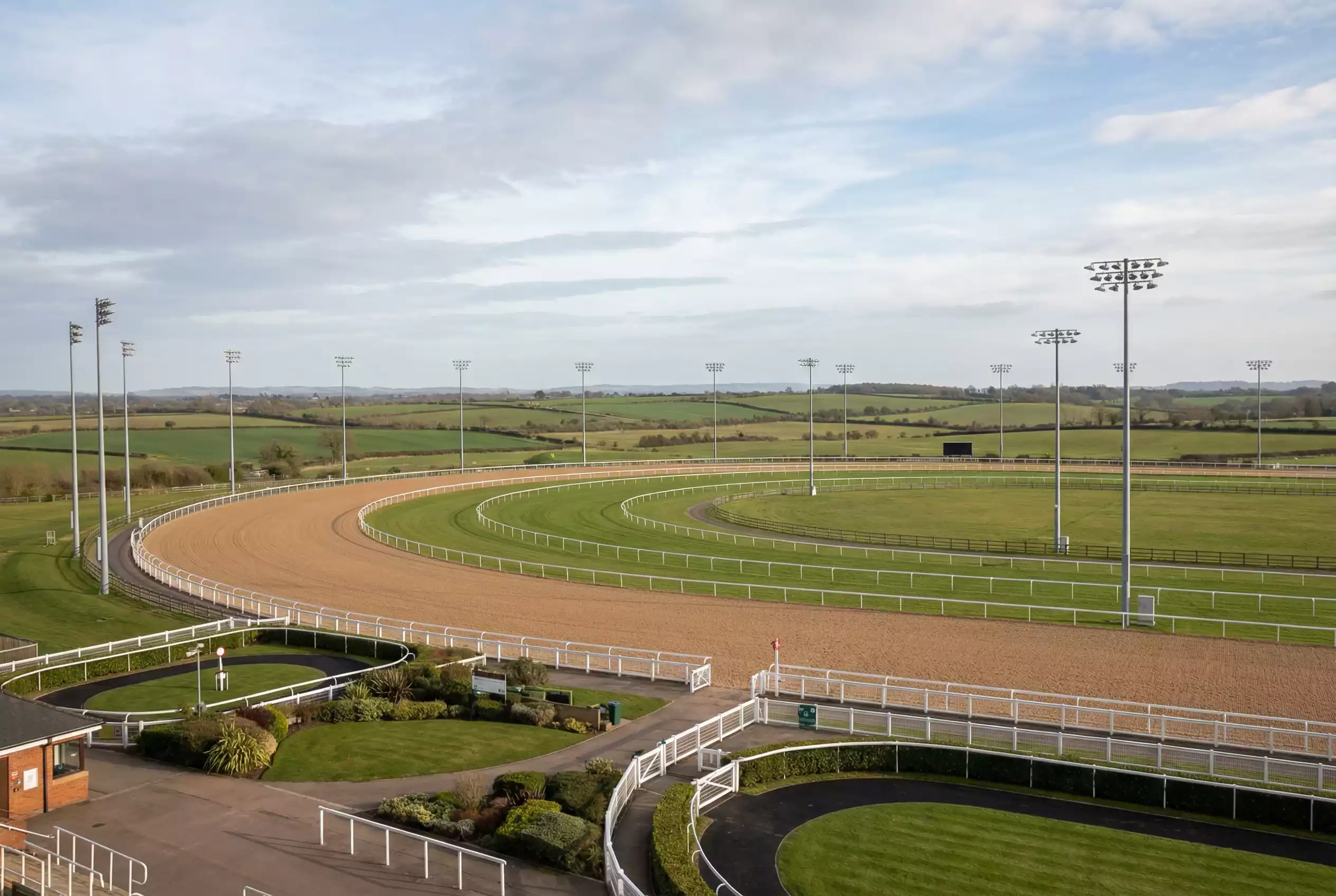
The all-weather track at Southwell is a left-handed oval of roughly a mile and a quarter in circumference — compact by British standards, closer in character to some of the tighter American ovals than to the sweeping galloping circuits of Newmarket or Doncaster. The home straight stretches approximately three furlongs, which is short enough to make position in the field matter considerably more than it would on a longer run-in. Races over five and six furlongs use a separate straight course that joins the oval, while everything from seven furlongs upwards takes the round track.
The bends are tight. That is not editorial commentary — it is a defining feature. The turns are sharper than at any of the other five UK all-weather courses (Chelmsford, Kempton, Lingfield, Newcastle and Wolverhampton), and they demand a horse that handles the geometry rather than one that simply has the best cruising speed. Jockeys who ride Southwell regularly know that the inside rail is prime real estate on the bends, and that wide runners around the final turn can lose two or three lengths without anyone in the stands noticing until the result flashes up.
The surface itself is Tapeta, a patented blend of wax-coated sand, rubber and synthetic fibres designed by Michael Dickinson, the former champion trainer turned track-surface engineer. Southwell switched to Tapeta on 7 December 2021, when the Winter Oaks Trial became the first race run on the new material. Before that date, the track had been Fibresand — and Fibresand only — since 1989, making it the sole UK venue to use that surface. The old Fibresand was a deep, demanding surface that rewarded front-runners and punished anything that wanted to come from behind. It produced its own ecosystem of course specialists and made Southwell form almost non-transferable to other tracks.
The move to Tapeta changed the racing character significantly. Mark Johnston, one of the most prolific winners in British training history, described the potential in straightforward terms: “Southwell is faultless in terms of scale and layout and, with a Tapeta surface, it can be an all-weather racetrack of the highest international standard.” — Mark Johnston, Trainer. The surface rides faster than Fibresand, produces less kickback (the spray of material thrown into following horses’ faces), and generally favours a wider range of running styles. Horses that could not act on the old surface now have a genuine chance, which has broadened the trainer demographic and made the results less predictable — a shift that has obvious implications for anyone studying Southwell racecourse results.
One detail that often goes unmentioned: the Tapeta surface was repaired and refurbished in 2024, following flood damage sustained during the severe weather events of autumn 2023. The Trent floodplain, which the course sits on, is a mixed blessing — flat ground ideal for racing, but vulnerable when the river breaches. The 2024 work restored the surface to full specification, and the track has raced consistently since.
The track offers distances from five furlongs to two miles on the all-weather. Sprint races over five and six furlongs are run on the straight course, while the round course accommodates everything else. The mile start is positioned on the far side, meaning horses face both bends, and the mile-and-a-quarter and mile-and-a-half trips require negotiation of the full oval plus extensions. The standard going description for the Tapeta surface is simply “Standard” or “Standard to Slow” — the material does not produce the range of conditions (Good, Good to Firm, Heavy) that turf courses generate, which is one reason all-weather form tends to be more consistent from card to card.
The camber on the bends deserves a mention. Southwell’s turns are not banked to the degree that some modern all-weather tracks are, which places additional emphasis on a horse’s natural balance and a jockey’s ability to maintain rhythm through the curve. Runners drawn wide in fields of twelve or more over seven furlongs and a mile face a measurable disadvantage, because they either concede ground on the first bend or use energy getting across to the rail. Draw data at Southwell is a subject that could fill a separate article — and does, elsewhere — but even at the level of a course guide, the tight, flat bends are the single most important feature to grasp about this track’s geometry.
The National Hunt Course: Turf, Fences and What Suits
The National Hunt course at Southwell is a separate entity from the all-weather track, and it has a character of its own that tends to surprise visitors. While the AW track runs on the inner circuit, the turf course takes a wider path and features its own set of obstacles. It is left-handed, like the all-weather, but the undulations and the nature of the fences give it a distinct profile. At The Races’ course guide puts it plainly: “Southwell is a superb jumping track, one of the best-maintained turf courses in Britain.” — At The Races, editorial. That assessment might sound generous for a track better known for its all-weather programme, but it reflects the quality of the groundwork that goes into maintaining a dual-purpose venue.
The chase course features conventional birch fences rather than the modified fences some courses have adopted. There are seven fences per circuit — three down the back straight, one at the top of the course, and three on the approach to and in the home straight. The fences are fair but not flimsy, and they have a reputation for finding out sloppy jumpers more reliably than some of the bigger, more forgiving tracks. Hurdle races take a similar path, with flights positioned at regular intervals around the circuit.
What suits the jumping track? The short straight means that hold-up horses need to be switched into position early on the final bend, or they will run out of ground. Front-runners and prominently ridden horses tend to do well, particularly in small-field chases where the pace can be controlled from the front. The ground varies by season, and because Southwell’s jumps fixtures are concentrated in the autumn and winter months, the going tends to be on the soft side of good. When the ground becomes genuinely heavy after prolonged rain, the tight turns amplify the stamina test — horses that handle soft ground on galloping tracks sometimes struggle with the combination of testing conditions and sharp bends at Southwell.
Distances on the National Hunt course range from about two miles to three miles for chases, with hurdle races starting from a minimum trip of around two miles. The course configuration means there are limited options for truly long-distance chases — three miles is about as far as the track can stretch, which keeps the jumping programme biased towards speed and agility rather than the relentless stamina required by a Haydock or Chepstow marathon.
Trainers who target Southwell’s jumps programme tend to be Midlands- and Northern-based yards for whom the course is a convenient raid. The prize money for National Hunt fixtures here is lower than at the major tracks, which shapes the quality of the fields and creates opportunities for shrewd operators who know the course. For form students, the key takeaway is this: Southwell jumps form tends to be most relevant to other tight, left-handed courses with conventional fences, and least transferable to the big, galloping right-handed tracks like Sandown or Kempton over jumps.
The drainage on the turf course is generally decent for a course situated on a river floodplain, but it has its limits. The Trent valley soil holds moisture well, which means that once the going turns soft in November, it rarely dries out until late spring. Race abandonments due to waterlogging do happen, though less frequently than at some more exposed National Hunt venues. When the ground is genuinely testing, field sizes contract sharply — trainers with options will re-route to better ground, leaving smaller fields of course regulars and ground-dependent types. That dynamic creates value opportunities for anyone prepared to study which trainers persist at Southwell when conditions deteriorate.
Facilities, Floodlights and the LED Lighting Milestone
For a mid-tier racecourse that stages mostly weekday and evening cards, Southwell’s infrastructure has received more investment in the past decade than most people in racing realise. The most significant upgrade came in 2019, when the course became the first racecourse in Europe to install LED floodlighting — a distinction that rarely gets mentioned in dispatches but has had tangible effects on the racing product. The previous sodium floodlights had done the job since the early days of evening racing at the venue, but the LED system delivers better light distribution, more consistent colour rendering for television cameras, and lower energy consumption across what amounts to hundreds of hours of illuminated racing per year.
The LED upgrade matters for two reasons beyond mere visibility. First, it improved the quality of the televised product. Southwell’s evening cards are broadcast on Sky Sports Racing to an audience that has grown accustomed to HD-quality pictures, and the old lighting created hotspots and shadows that made for difficult viewing, particularly on the far side of the course. The new system eliminated most of those issues. Second, it reduced operational costs at a venue that runs more evening meetings than almost any other UK track — savings that feed into the financial viability of staging fixtures with relatively modest prize money.
Beyond the floodlights, the course offers a Seasons Restaurant for hospitality, several bars and food outlets, and viewing areas across multiple enclosures. It is not a luxury experience and does not pretend to be — Southwell is a working racecourse built for regular use, and the facilities reflect that function. The parade ring is compact but well-positioned, giving racegoers close access to the horses, and the grandstand provides decent views of the final two furlongs. On busier cards, such as feature meetings or holiday fixtures, the atmosphere lifts noticeably from the usual midweek crowd.
One practical detail worth noting: Southwell does not have a separate members’ enclosure in the traditional sense. The pricing structure typically offers a single general admission level with optional upgrades to hospitality packages. This makes it one of the more accessible courses for casual visitors who want to see live racing without navigating the class-coded enclosure system that operates at many larger venues.
Location, Transport and Rolleston Station
The racecourse sits just outside Rolleston, a village roughly two miles east of Southwell itself and about fifteen miles north-east of Nottingham. By road, the A612 from Nottingham is the most common approach; from the north, the A617 via Mansfield drops you within a few miles of the course. Parking is on site and free on most racedays, though space can tighten on busier cards, particularly the evening fixtures that draw a local crowd after work.
The rail link is one of Southwell’s more unusual features. Rolleston station, on the Nottingham to Lincoln line, is a short walk from the course — close enough that the racecourse historically marketed itself as accessible by train. In practice, the service is limited: trains are infrequent, the station is a request stop on some services, and the last train back to Nottingham on an evening meeting can leave before the final race. It is worth checking timetables carefully rather than assuming a connection will be there. Most regular visitors drive.
For anyone travelling from further afield, Newark North Gate station (on the East Coast Main Line) is the nearest major rail hub, approximately seven miles from the course. A taxi from Newark to Southwell takes about fifteen minutes and is the practical option for anyone arriving by intercity train. From the East Midlands, Nottingham station offers more frequent services and is roughly a thirty-minute drive from the racecourse.
Planning Conditions and Race Limits
Here is a detail that even regular Southwell punters rarely know: the racecourse operates under planning conditions imposed by the local authority, Newark and Sherwood District Council, that cap the number of race meetings at 80 per year. That ceiling dates back to 1989, when the original planning permission for all-weather racing was granted, and it has been a fixed constraint ever since. A separate condition, introduced through a 2007 amendment, limits the course to 12 Sunday fixtures per year.
Eighty meetings might sound like plenty, but in the context of a venue that could theoretically race almost every day on its all-weather surface, it is a binding constraint. The BHA’s fixture list allocates dates across all British racecourses, and Southwell typically receives somewhere between 55 and 65 fixtures per season — well inside the planning limit but closer to it than most observers assume. The Sunday restriction is occasionally more acute: demand for weekend racing slots from broadcasters and bookmakers means that the twelve available Sundays are allocated carefully, often weighted towards periods when the racing calendar is thinnest.
The planning conditions also govern operating hours, noise levels and traffic management, all of which become more relevant during evening racing under floodlights. Rolleston is a small village, and the relationship between the racecourse and its immediate neighbours is one that ARC manages actively. Any significant change to the fixture programme — adding more evening meetings, for example, or extending operating hours — would require a planning application and public consultation.
Why does this matter for anyone interested in Southwell racecourse form? Because the planning ceiling shapes the quality and distribution of fixtures. If the course could host 120 meetings a year, fields might thin and prize money per race would drop. The cap forces a concentration of racing that, paradoxically, keeps the product more competitive than it would otherwise be. Fewer fixtures mean that each card carries a reasonable number of races with adequate field sizes, rather than diluting the programme across too many dates.
Arena Racing Company and Southwell’s Position in the ARC Portfolio
Southwell is owned and operated by Arena Racing Company, the largest racecourse group in the United Kingdom. ARC’s portfolio spans 16 venues, including Doncaster, Lingfield, Windsor, Wolverhampton and a string of other courses that between them stage a substantial proportion of British racing’s total fixture list. The group welcomes more than 1.2 million visitors per year across its venues and runs over 300 racedays annually — numbers that make it the backbone of everyday British racing, even if its courses rarely feature in the sport’s headline moments.
ARC is also the majority shareholder in Sky Sports Racing, the dedicated racing channel available in approximately 14 million UK households. This vertical integration — owning both the venues and a significant broadcasting outlet — gives ARC a commercial model that differs from standalone racecourses. Southwell’s evening fixtures, in particular, are a regular feature of the Sky Sports Racing schedule, providing content for the channel during slots that would otherwise go dark. The relationship is symbiotic: Sky Sports Racing needs cards to broadcast, and Southwell needs the media rights income that comes with televised meetings.
Within the ARC portfolio, Southwell occupies a specific niche. It is not the group’s flagship (that role falls to Doncaster, home of the St Leger), nor is it a destination course for big-day spectators. Instead, it functions as a high-frequency, low-overhead venue that generates a steady stream of fixtures and media income. The investment in LED floodlighting, the switch to Tapeta, and the ongoing maintenance of both the all-weather and turf courses all reflect ARC’s strategy of keeping its mid-tier venues commercially viable through operational improvements rather than architectural statements.
For punters and form analysts, the ARC connection matters in a few practical ways. First, ARC courses tend to share certain operational standards — the quality of the going reports, the consistency of the race-day timetable, the availability of information through the Sky Sports Racing broadcast. Second, trainers who operate across the ARC circuit develop familiarity with multiple venues in the group, which creates patterns in where they send certain types of horse. A trainer who frequents Wolverhampton and Southwell, both Tapeta tracks under ARC ownership, may target both venues with the same string of all-weather horses — and that pattern shows up in the results data. Understanding who owns Southwell racecourse, and how that ownership connects to the broader racing landscape, is a small but useful piece of the analytical puzzle.