
- All-Weather Racing at Southwell Has Quietly Become One of British Racing's Most Competitive Products
- What Is Tapeta and How Does It Ride at Southwell
- Field Size Data: Why AW Consistently Outperforms Turf in Winter
- The All-Weather Championships: Southwell's Role and Qualifying Pathway
- Floodlit All-Weather: Evening Cards and Their Betting Patterns
- Does AW Form Translate to Turf? What the Crossover Data Shows
- Month-by-Month: When Southwell AW Racing Peaks
All-Weather Racing at Southwell Has Quietly Become One of British Racing’s Most Competitive Products
There is a perception, still common among casual racing followers, that all-weather racing is the poor relation of the turf — a winter filler, a midweek distraction, something to bet on when the real stuff is frozen off. Southwell all-weather racing does not fit that narrative any more. The data from the British Horseracing Authority’s own reporting tells a different story: in Q1 2024, 73% of Flat races on Core fixtures attracted eight or more runners, the best figure since 2007, and all-weather tracks were a major driver of that improvement. When turf racing struggled through a winter of abandonments and waterlogged ground, the synthetic surfaces kept producing competitive fields with enough depth to sustain a serious betting product.
Southwell sits at the centre of that story. As one of six all-weather venues in Britain and one of only three running on Tapeta, it stages a year-round programme of Flat racing that generates more fixtures than many turf courses manage across an entire season. The switch from Fibresand to Tapeta in late 2021 modernised the racing surface, broadened the pool of trainers willing to send horses, and brought the track into line with the specifications used at Newcastle and several major North American venues. The result is a racing product that has gained credibility in the training community and — more importantly for bettors — produces form that is increasingly reliable and transferable.
This article examines the all-weather product at Southwell from the angles that matter most: the surface itself, the field sizes that determine competitiveness, the All-Weather Championships pathway that gives the track a link to the sport’s bigger prizes, the evening cards that have become a fixture of the British betting calendar, and the seasonal patterns that shape when and how the course races. If Southwell all-weather racing is not yet on your radar, the numbers in the following sections should change that.
What Is Tapeta and How Does It Ride at Southwell
Tapeta is a proprietary all-weather surface developed by Michael Dickinson, a former champion trainer who pivoted to track engineering after relocating to the United States. The material is a blend of silica sand, wax and synthetic fibres — a combination designed to provide consistent cushioning, reliable drainage and minimal kickback compared to older surfaces. Dickinson’s objective was a surface that behaved as close to good turf as possible while being impervious to the weather variations that make turf racing unreliable through the British winter.
Southwell installed Tapeta in late 2021, replacing the Fibresand that had been in place since 1989. The first race on the new surface was the Winter Oaks Trial on 7 December 2021. The change was significant not only for Southwell but for the wider all-weather landscape: it eliminated the last Fibresand track in Britain and brought Southwell into the same surface family as Newcastle, the other major Tapeta venue in the UK.
John Gosden, a Hall of Fame trainer and five-time champion, endorsed the switch at the time of the announcement: “The Tapeta surface is both safe and true and Southwell’s configuration is akin to many of the top racecourses in the USA.” — John Gosden, Trainer. That comparison to American tracks is more than flattery. Tapeta is used at several prominent US venues, and its characteristics — faster than Fibresand but with less jar than Polytrack — produce race times and running styles that sit comfortably between European turf and American dirt racing.
At Southwell specifically, the Tapeta rides on the quicker side of standard. The going is typically recorded as “Standard” or occasionally “Standard to Slow” after sustained rainfall, but the variation is narrow compared to turf. This consistency is one of the surface’s selling points for form analysts: a horse that ran on Standard ground at Southwell in January will encounter essentially the same conditions in July, removing one of the biggest variables from the equation.
The surface was refurbished in 2024 following flood damage from the autumn 2023 weather events. The Trent floodplain that Southwell occupies made the course vulnerable to the river’s behaviour during that particularly wet period, and the repair work restored the Tapeta to its original specification. Since the refurbishment, the surface has performed consistently and without the drainage issues that plagued several meetings in late 2023.
Field Size Data: Why AW Consistently Outperforms Turf in Winter
Field size is the metric that underpins everything else in racing — competitiveness, betting liquidity, spectacle, integrity. A six-runner handicap is a different product from a twelve-runner one, and the gap between the two affects everything from the each-way terms bookmakers offer to the likelihood of form working out. On this measure, Southwell all-weather racing has been performing strongly. That 73% figure for Flat races with eight or more runners on Core fixtures — the best since 2007 — was driven in large part by all-weather venues providing consistency through the winter months when turf cards were being abandoned or running on unsuitable ground.
The reason is straightforward mechanics. Turf racing depends on ground conditions, which depend on weather, which in a British winter is roughly as predictable as a lottery draw. Trainers with valuable horses will not risk them on bottomless ground or on courses where the going is an unknown quantity until morning inspections. All-weather surfaces remove that uncertainty. A trainer entering a horse at Southwell knows, with a high degree of confidence, that the meeting will go ahead and that the surface will be within a narrow range of Standard. That reliability translates directly into fuller declarations and larger fields.
The quality of the horse population backing up those field sizes has also been moving in the right direction. The BHA reported that 2,052 individual Flat horses achieved a BHA rating of 85 or higher in 2024, up from 1,983 the previous year — a 3.5% increase that reflects a growing population of competent performers. While the upper echelons of Flat racing still concentrate at the major turf meetings, the depth of mid-range talent available for all-weather programmes has expanded, and Southwell benefits from that trend as a venue that offers regular opportunities for horses rated in the 50-85 range.
The picture in National Hunt is less encouraging. The same BHA report noted that the number of horses rated 130 or above in the Jump code fell from 787 to 716 — a 9% decline. That contraction in the jumps population does not directly affect Southwell’s all-weather programme, but it is relevant context for the venue’s dual-purpose identity. The jump fixtures at Southwell draw from a shrinking pool of horses, which may over time affect the viability of the turf programme relative to the all-weather one.
For bettors, the field-size data matters because it determines the type of races available at Southwell. Larger fields mean more handicaps, more each-way opportunities, more competitive races where form study can gain an edge over those betting on impulse. The consistent field sizes on the all-weather also mean that historical trends — draw biases, pace advantages, trainer patterns — remain statistically relevant from season to season in a way that they cannot always be on turf courses where conditions fluctuate wildly.
The All-Weather Championships: Southwell’s Role and Qualifying Pathway
The All-Weather Championships is the initiative that gives synthetic-surface racing in Britain a narrative arc beyond individual results. Run as a season-long series across all six UK all-weather courses — Chelmsford, Kempton, Lingfield, Newcastle, Southwell and Wolverhampton — it culminates in a Finals Day at Newcastle worth £1 million in prize money, the richest all-weather racecard staged in Europe. A separate All-Weather Vase fixture, worth over £390,000, runs at Lingfield on the same day. Southwell plays a specific part in this structure as a qualifying venue.
The qualifying mechanism is straightforward: a horse must run a minimum of three times on an all-weather surface in Britain, Ireland or France during the qualifying period (roughly October to April) and be rated high enough by the BHA handicapper to make the cut for a Finals race. In earlier seasons, designated Fast Track Qualifier races were staged at participating tracks, but from 2024 these were replaced by Trials Days — higher-value fixtures at Newcastle and Lingfield that serve a similar purpose of showcasing potential finalists. Southwell contributes to the qualifying pathway by hosting regular all-weather fixtures where horses can accumulate the required number of runs, giving local and circuit-regular horses a route into the Championship picture without needing to travel to the more high-profile southern venues.
Southwell’s role in the Championships is specific rather than dominant. The course does not host the Finals Day itself, but it provides essential qualifying opportunities that keep the pathway accessible. For trainers based in the Midlands and North, Southwell’s qualifiers are logistically convenient and competitively manageable, which makes them natural targets for horses with all-weather ability and Championship ambitions.
The Championship structure has had a notable effect on the quality of Southwell’s winter programme. Before the initiative existed, many of the better all-weather horses would be reserved for the southern tracks with higher prize money, leaving Southwell to field cards of modest handicappers. The qualifying requirements have changed that calculation: a trainer with a decent all-weather horse now has a strategic reason to run at Southwell if the opposition looks weaker than at Kempton or Lingfield, accumulating the necessary qualifying runs in a less competitive environment. That dynamic has lifted field quality and created a category of Southwell results that carry more weight in form analysis than the everyday programme.
For punters, the Championship races at Southwell are worth identifying in advance. They tend to attract better horses, more competitive fields and more informed betting markets than the standard midweek card. The form produced in these races is also more transferable to other all-weather venues, because the horses are running at a level where surface and track configuration matter less than raw ability. Tracking which horses accumulate qualifying runs through Southwell gives an early read on the contenders who will appear on Finals Day.
The Championship also serves a reputational function for Southwell that should not be overlooked. By participating in a structured, season-long competition with identifiable stakes, the course aligns itself with a product that commands attention from mainstream racing media. Qualifying races at Southwell receive previews and post-race analysis that a standard Tuesday evening handicap would not, and that exposure feeds back into the betting market. More media attention means more eyeballs, which means more liquidity, which means more efficient markets — a virtuous cycle that ultimately benefits anyone who takes their Southwell all-weather analysis seriously.
Floodlit All-Weather: Evening Cards and Their Betting Patterns
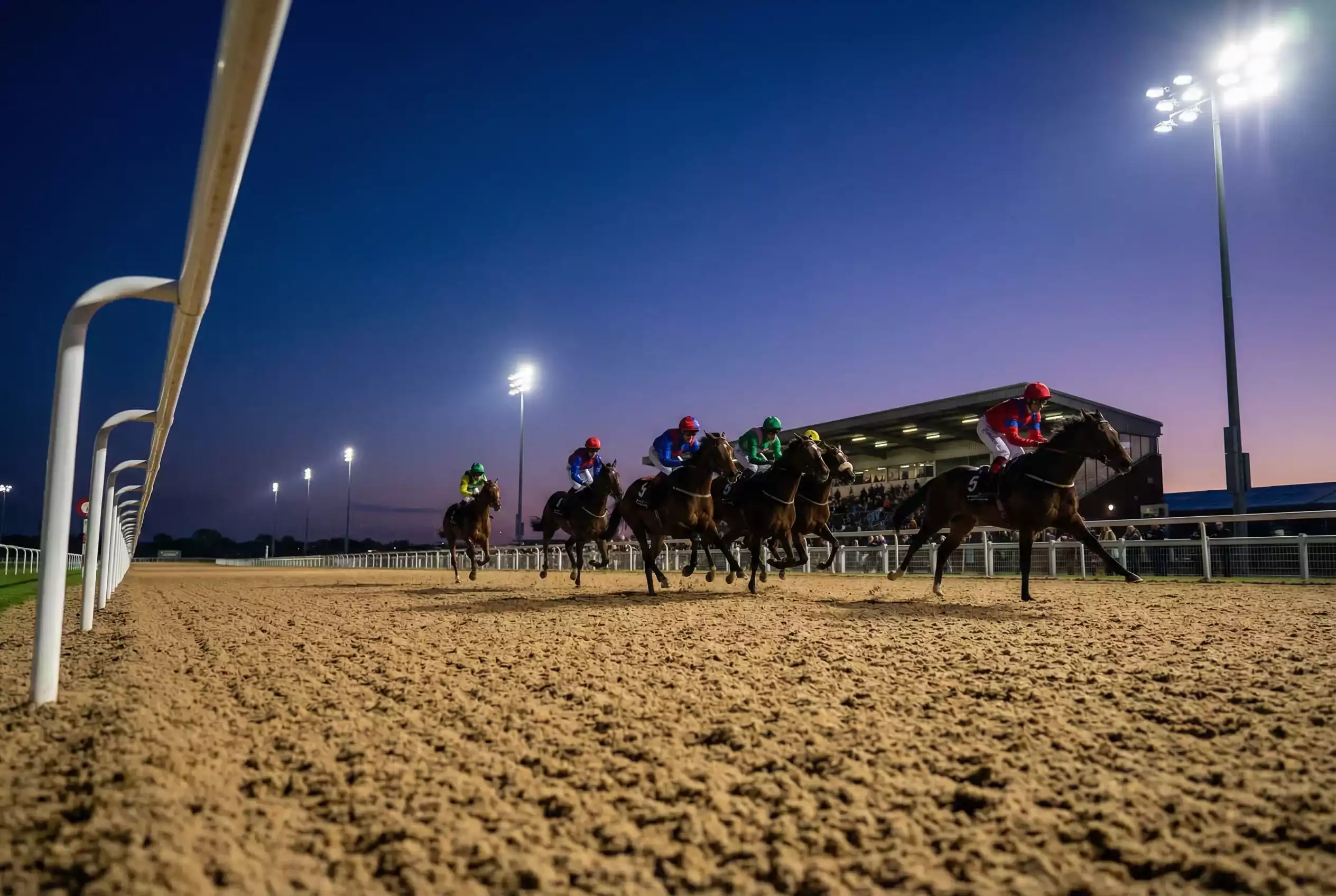
Southwell’s evening cards are a staple of the British racing schedule, running year-round under the LED floodlighting system installed in 2019 — a system that made the course the first in Europe to use LED technology for horse racing. The switch from the old sodium lighting was not merely cosmetic. It improved the broadcast quality for Sky Sports Racing, reduced energy consumption across what amounts to dozens of evening fixtures per season, and eliminated the uneven light distribution that had been a longstanding issue for jockeys navigating the bends in the final furlongs.
The evening programme at Southwell typically features six or seven races, predominantly low- to mid-grade handicaps and conditions races on the all-weather surface. These are Class 5, 6 and 7 events with modest prize money, and the fields tend to be drawn from the all-weather circuit regulars — horses and trainers who know the track and race at this level as a matter of routine. The Class profile means that the racing is competitive within its grade but not aspirational: these are not races that feature future Group horses, and the form should be assessed within that context.
The betting dynamics on evening cards have their own characteristics. Liquidity in the betting exchanges tends to be lower for Southwell evening meetings than for daytime cards at more prominent venues, which means that prices can move more sharply on relatively small amounts of money. For bookmaker bettors, the starting prices at evening Southwell meetings are sometimes more generous than daytime equivalents because the market-making process has less information and less volume to work with. That creates opportunities for informed bettors who have done their homework on the card — but it also means that the margin for error is thinner, because when information does arrive in the market, it can shift prices quickly and dramatically.
The atmosphere of an evening card at Southwell is its own thing. The crowd is smaller and more focused than a Saturday afternoon — predominantly serious racing people rather than social racegoers. The floodlights give the track a slightly surreal quality that photographs well and televises better than it probably should. For anyone considering a visit, the evening meetings are arguably the most characterful way to experience the course, provided you are comfortable with the reality that the racing is a tier or two below what you would see on a weekend afternoon at one of the major tracks.
Does AW Form Translate to Turf? What the Crossover Data Shows
This is the question that every form student encounters eventually: does a horse’s all-weather record tell you anything useful about how it will perform on turf? The answer, as with most things in racing, is complicated — but the Tapeta era at Southwell has made it somewhat less so than the Fibresand period.
On Fibresand, Southwell form was essentially a closed system. The surface was so unique — deep, demanding, heavily biased towards front-runners — that a horse could win ten races there and prove completely useless on turf or even on other all-weather surfaces. The classic Southwell specialist was a horse that exploited the Fibresand characteristics and had no transferable ability whatsoever. Trainers knew this, bettors learned it the hard way, and the course’s results existed in a bubble.
Tapeta has opened that bubble considerably. The surface is closer in its riding characteristics to good turf than Fibresand ever was, and horses that win on Tapeta at Southwell have a meaningfully better chance of reproducing that form on turf or on other synthetic surfaces. The crossover is not perfect — no artificial surface truly replicates turf — but the gap has narrowed. A horse that shows decent form at Southwell on Tapeta is now worth considering for a subsequent turf run, particularly if the turf ground is on the good side and the horse has shown adaptability in its running style.
The crossover tends to work better in some directions than others. Tapeta-to-turf form transfers most reliably for horses rated in the 60-90 range running in handicaps, where the class of opposition is broadly similar at both types of venue. At the upper end of the scale, better horses tend to run on turf as their primary surface and visit the all-weather only for specific reasons — winter fitness runs, prep races, or because their trainer wants to build a qualifying path for the All-Weather Championships. The form of these better horses on all-weather tends to be reliable precisely because they are operating below their ceiling.
Going the other direction — turf form applied to Southwell all-weather — the conversion rate depends heavily on which turf surface the horse has been racing on. Horses with form on good to firm ground on flat, galloping tracks sometimes struggle with Southwell’s tight bends regardless of the surface, while those experienced on tighter, turning tracks often adapt more readily. The track configuration, rather than the surface alone, is frequently the stumbling block for turf form transferring successfully to Southwell.
Month-by-Month: When Southwell AW Racing Peaks
The all-weather programme at Southwell does not distribute evenly across the calendar, and understanding the seasonal peaks and troughs is useful for anyone who follows the course regularly. The BHA’s national fixture plan for 2025 scheduled 1,460 fixtures across all British courses, with all-weather venues shouldering a disproportionate share of the winter workload. Southwell’s contribution to that total is concentrated in certain months.
The busiest period for Southwell all-weather is typically November through March, when turf Flat racing is effectively dormant and the National Hunt programme absorbs only a fraction of the available racing population. During these months, Southwell can stage four or five fixtures in a single week — a mixture of afternoon and evening cards that fill the gaps left by the absence of turf racing. The fields during this peak period tend to be the largest and most competitive of the year, partly because trainers have fewer alternative options for giving their horses a run and partly because the betting public is most engaged with all-weather racing when there is nothing else to watch.
April and May bring a transition. As the turf season returns, Southwell’s all-weather programme contracts to make room for the summer schedule at grass tracks. The course still races through these months — the fixture list does not pause entirely — but the frequency drops and the quality of entries can dip as trainers redirect their better horses towards the turf programme. June through September represents the quietest stretch for Southwell all-weather, though the course continues to stage regular evening meetings that serve the betting market and provide broadcasters with content.
The autumn revival begins in October, when the first wave of turf abandonments reminds everyone why all-weather venues exist. Southwell’s fixture count ramps up again, and the cycle repeats. For bettors, the seasonal pattern has practical implications. The peak winter months produce the most reliable form — larger fields, more competitive racing, more data to work with — while the summer meetings can be harder to assess because the fields are thinner and the class of horse tends to be lower. Timing your engagement with Southwell all-weather results around the seasonal rhythm is a small but genuine edge.